
A mole present since childhood that fades, diminishes, and then seems to have disappeared: the phenomenon is puzzling, but it is documented in dermatology. The disappearance of a mole remains rare and does not follow a unique pattern. Depending on the patient’s age, the mechanism involved, and associated signs, the clinical significance varies considerably.
Disappearance of a nevus in children and adults: two different interpretations
The context in which a mole disappears radically changes its interpretation. In children or adolescents, a nevus that gradually lightens is most often due to a benign process. The skin evolves, melanocytes redistribute, and some pigmented lesions eventually blend into the surrounding complexion.
In adults, the situation calls for more caution. An unexplained disappearance should prompt the search for an atypical pigmented lesion or another dermatological diagnosis. To understand why a mole disappears, at least three distinct mechanisms must be distinguished: immune regression (halo nevus), age-related progressive depigmentation, and tumor regression in the case of melanoma.
| Criterion | Child / Adolescent | Adult |
|---|---|---|
| Frequency of spontaneous disappearance | Uncommon but documented | Rare, requires medical advice |
| Most common mechanism | Redistribution of melanocytes, benign halo nevus | Immune reaction, depigmentation, possible tumor regression |
| Alert level | Low if appearance is regular and stable | High if rapid change or associated signs |
| Recommended action | Annual clinical monitoring | Immediate consultation with a dermatologist |

Halo nevus and depigmentation: when the immune system erases a mole
The halo nevus (Sutton’s nevus) represents the best-characterized case of spontaneous disappearance. A white, depigmented ring forms around the mole. Gradually, the central lesion loses its color and then fades away. This phenomenon results from a local immune reaction: lymphocytes target and destroy the melanocytes of the nevus.
This mechanism is frequently observed in adolescents and young adults. It sometimes affects several moles simultaneously. In the vast majority of cases, the process is benign.
Age-related depigmentation follows a different path. With skin aging, some nevi lose their pigment without a visible halo. They become flesh-colored and then blend into the skin. The mole has not actually disappeared; it has become invisible to the naked eye. A dermatologist equipped with a dermatoscope can still detect the residual structure.
False disappearance after laser treatment
The laser used for aesthetic purposes can destroy the pigment of a nevus without eliminating all the melanocytes. The mole appears to have visually disappeared, but melanocyte cells may persist deep down. This situation complicates subsequent monitoring, as any potential malignant change becomes more difficult to detect during a standard clinical examination.
Regression melanoma: the signal that disappearance may mask
Some melanomas exhibit partial or total spontaneous regression. The immune system attacks the tumor cells, resulting in a depigmented or scarred area at the site of the initial lesion. The mole seems to fade away, but the tumor may have already spread.
The disappearance of a mole in adults should never be reassuring on its own. The real alert point is not isolated disappearance, but the combination of disappearance and change: rapid changes in color, shape, relief, bleeding, or the appearance of an irregular depigmented area.
- A nevus that disappears symmetrically, slowly, without symptoms, points to a benign process (halo nevus, age-related involution).
- A mole that partially fades, leaving irregular pigmented areas, requires a biopsy to exclude a regressing melanoma.
- A history of more than fifty moles, a light phototype, or repeated sun exposure increases the risk that the disappearance masks a malignant lesion.
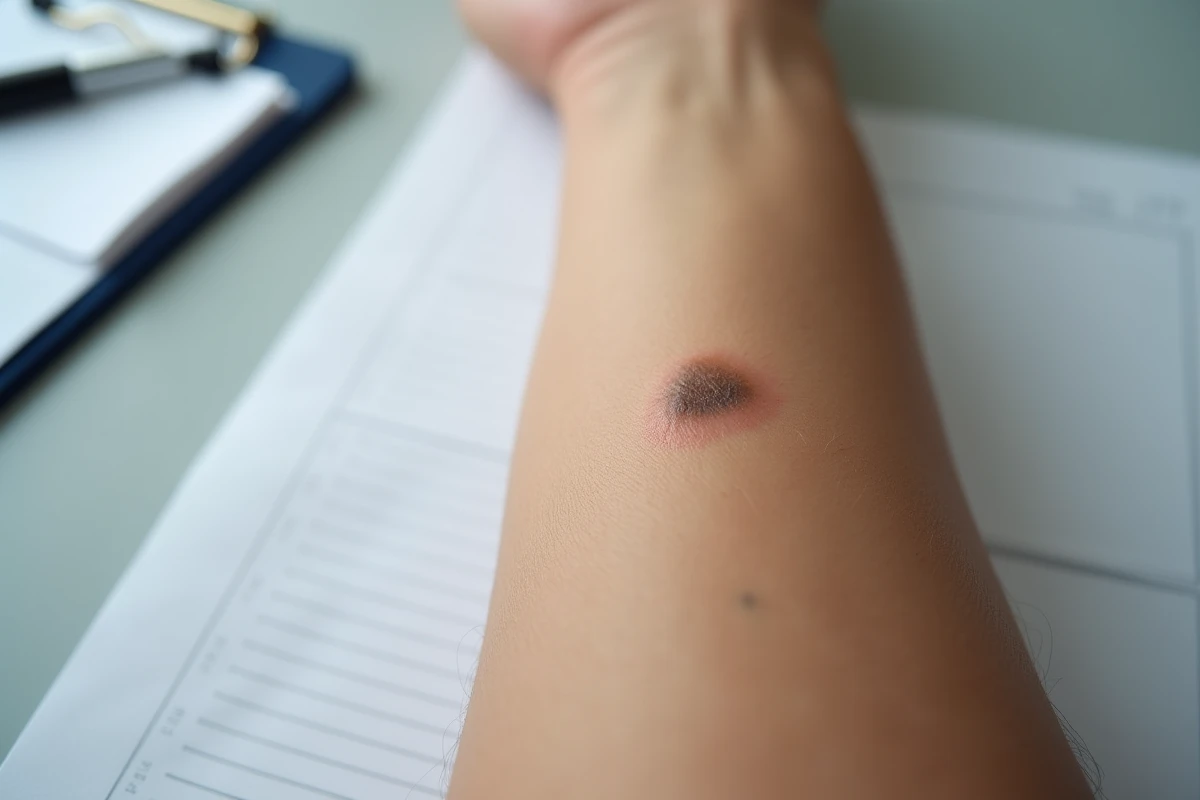
Dermatological monitoring of a fading mole
The ABCDE rule (asymmetry, borders, color, diameter, evolution) remains the reference tool for self-monitoring, but it was designed to evaluate visible lesions. A fading nevus partially escapes this framework, because its color and borders change precisely during the process.
The dermatoscope allows for the analysis of residual pigmented structures beneath the surface. In case of doubt, a biopsy distinguishes between a benign halo nevus and a regressive melanoma. Histological examination reveals the presence or absence of atypical cells.
Recommended follow-up frequency
An adult whose mole disappears without visible explanation should consult a dermatologist within the following weeks, without waiting for the annual check-up. Individuals with many nevi or a family history of skin cancer benefit from regular photographic mapping, which facilitates the detection of any changes, including disappearance.
The disappearance of a mole is neither a myth nor a reason for systematic panic. In children, the phenomenon almost always pertains to a natural evolution. In adults, it warrants prompt dermatological advice to rule out a regressing melanoma, the only scenario where the fading of a nevus constitutes a genuine warning signal.