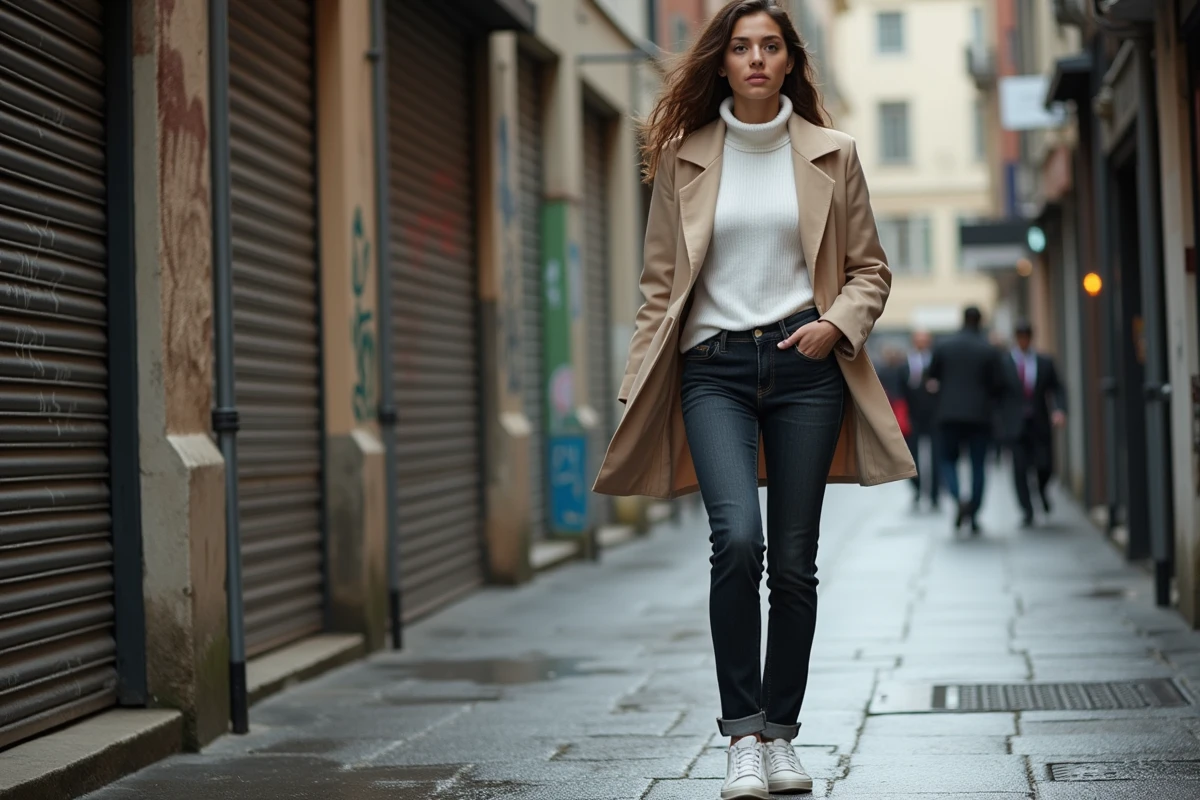
The urban look refers to a style of clothing born from street culture, based on three technical pillars: relaxed cuts, functional materials, and a layering play. Far from a simple assembly of sneakers and sweatshirts, this style adheres to rules of proportion and chromatic coherence that allow for a transition from city travel to a casual office without changing outfits.
Dopamine dressing palette: the colors that change the urban wardrobe
Black, heather gray, and off-white have long dominated the streetwear wardrobe. For a few seasons now, a trend called dopamine dressing has shaken up this sobriety. The principle is simple: inject a bold color into a daily piece, a lavender hoodie, butter yellow cargo pants, a glacier blue windbreaker, to create a focal point without overwhelming the silhouette.
This approach works because it relies on basics. Acid green cargo pants worn with a white t-shirt and neutral sneakers remain readable. The color catches the eye, while the rest of the outfit anchors it. It is this contrast between a vibrant piece and a sober background that distinguishes dopamine dressing from the total colorful look, which is often harder to master on a daily basis.
For those exploring these palettes, La Mode Urbaine’s fashion site regularly details color combinations suitable for a street wardrobe.
Urban walking shoes and discreet gorpcore: the functional shift
The choice of shoes determines the credibility of an urban look as much as its actual comfort. A recent movement blurs the line between hiking shoes and city sneakers. Norwegian-stitched models, cushioned soles, and technical leather appear in streetwear outfits without giving the impression of setting off on a trek.
Discreet gorpcore and everyday comfort
This style, sometimes referred to as discreet gorpcore, is distinguished from pure gorpcore (fluorescent Gore-Tex jacket, visible carabiners) by its restraint. The technical properties (waterproofing, cushioning, leather flexibility) are retained within a sober design, often brown, black, or khaki.
Brands specializing in urban walking emphasize an argument that goes beyond fashion: foot comfort becomes a style criterion in its own right. A well-designed midsole changes posture, and thus the way an outfit falls. Wearing shoes designed for miles of pavement alters one’s gait, affecting the overall appearance.
- Cushioned and flexible sole, suitable for sensitive feet, to endure a full day in the city without fatigue.
- Technical leather or water-repellent material that withstands showers without sacrificing urban aesthetics.
- Minimalist design with a slightly vintage-outdoor look, compatible with slim jeans as well as cargo pants.
Building an urban outfit: proportions and layering
The streetwear silhouette is read in volumes. The basic principle is to balance a loose piece with a fitted piece. Wide pants call for a shorter or fitted top. An oversized hoodie works better with straight jeans than with baggy joggers.
The three-layer rule
Urban layering follows a logic borrowed from technical clothing: a base layer close to the body (t-shirt, tank top), a mid-layer (sweatshirt, open shirt, light jacket), and a visible outer layer (jacket, overshirt, windbreaker). Each layer should be removable without ruining the whole.
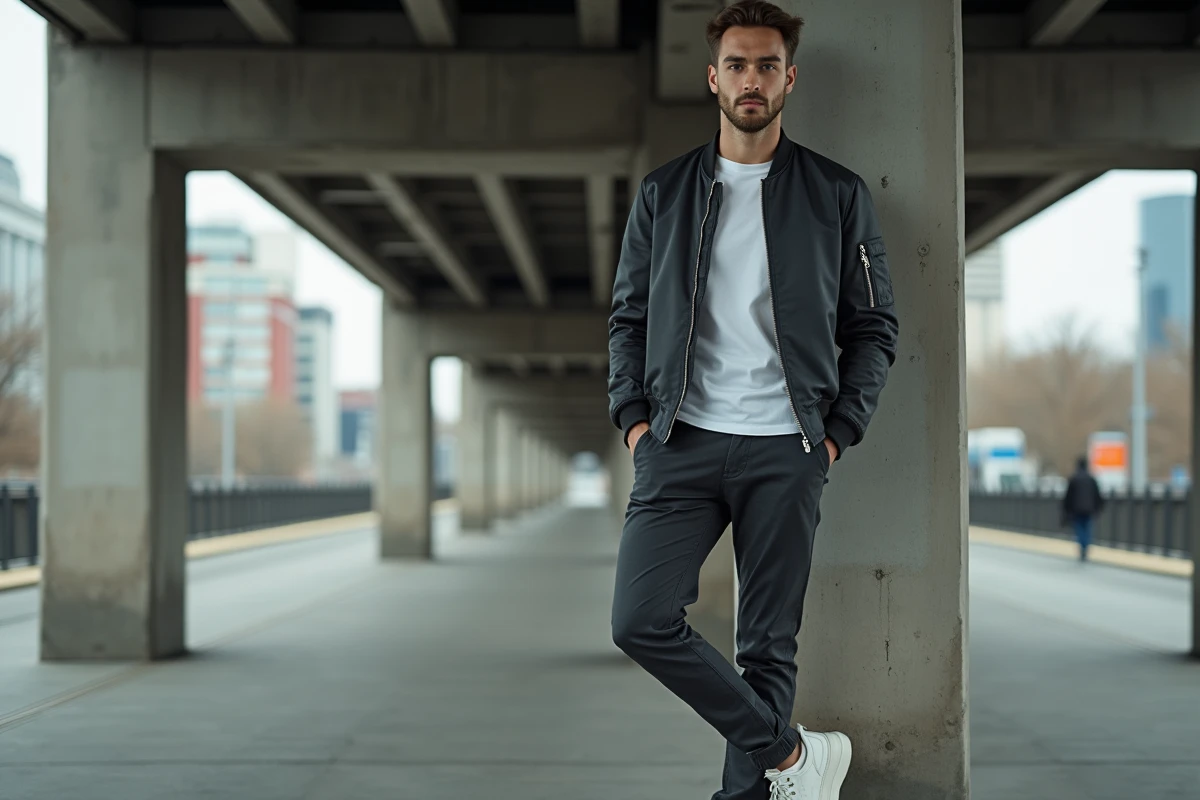
In practical terms, an effective casual outfit can be summarized as a white t-shirt, an open flannel overshirt, and a bomber jacket on top. Straight jeans complete the bottom, and a pair of white sneakers or urban walking shoes finish the look. Three layers are enough to create visual depth without falling into accumulation.

Accessories: fewer pieces, more impact
A canvas bucket hat, a technical cap, or a fanny pack worn crossbody is enough to punctuate an outfit. A common mistake is to pile on accessories (watch, bracelet, chain, ring, cap) in hopes of adding effects. The result dilutes the reading of the silhouette instead of enhancing it.
Only one visible accessory per area of the body (head, wrist, torso) keeps the whole readable. This discipline also applies to logos: only one visible logo per outfit avoids the billboard effect.
Streetwear and ethical fashion: choosing durable pieces
The urban style naturally encourages the longevity of clothing. A good thick fleece hoodie, raw denim jeans that age well, a heavy canvas jacket: these pieces gain character over time. Favoring dense materials and solid finishes (reinforced seams, metal closures) means building a wardrobe that ages well rather than renewing it every season.
- A raw denim jean becomes rigid and then softens by conforming to the body shape, giving it a unique fit after a few months.
- A thick cotton t-shirt retains its shape after washing, unlike thin versions that quickly warp.
- A canvas or ballistic nylon jacket withstands daily friction (backpacks, transport) without peeling or pilling.
This reasoning aligns with an underlying trend: ethical fashion and streetwear do not oppose each other. Buying fewer, better-chosen pieces produces a better stylistic result than a rapid rotation of low-quality clothing.
Ultimately, the stylish urban look rests on a handful of clear decisions: a controlled palette, shoes designed for the pavement, balanced proportions, and materials that stand the test of time. The rest is a matter of detail, and it is precisely in these details, a well-measured pant cuff, an unexpected color on a basic, that personality takes precedence over trend.