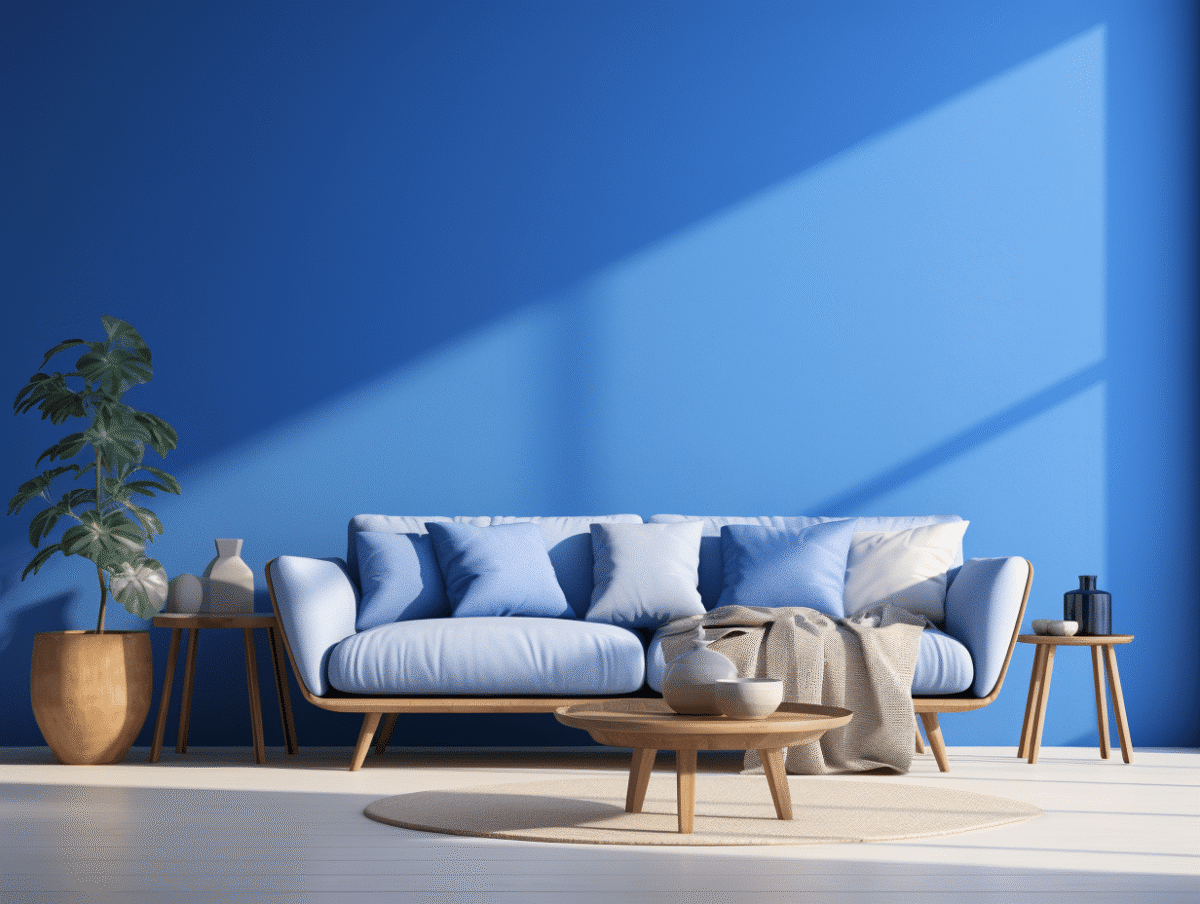
Klein Blue, with its intense and captivating hue, is the work of Yves Klein, an avant-garde artist of the 20th century. This unique pigment, known as International Klein Blue (IKB), was developed by Klein in collaboration with chemists to achieve an unparalleled depth of color that seemed almost beyond physical dimensions. Its uniqueness lies in its ability to absorb light and create an illusion of depth and infinite space. This hypnotic shade has transcended the art world to find its way into interior decoration, bringing a touch of modernity and bold elegance to contemporary spaces.
The genius behind Klein Blue: history and technique
In the heart of Paris, amidst the tumult of the 1950s, Yves Klein, a French artist, embarked on a quest that would revolutionize the world of contemporary art. A pioneer of New Realism, Klein aspired to an immaterial pictorial sensitivity, a form of pure expression devoid of any figuration. It was in this perspective that he set out to create the perfect blue. His fascination with ultramarine blue led him to experiment with chemists to give birth to an unprecedented hue: IKB, International Klein Blue. More than just a pigment, IKB became the symbol of an aesthetic quest, a vehicle for the immateriality of Klein’s art, embodying his imprint in the eternity of infinite blue.
The genesis of IKB is inseparable from Klein’s artistic approach, which always sought to capture the infinite and make it tangible. It was through painting that he chose to manifest this aspiration for vastness. IKB, with its luminous and matte qualities, is close to ultramarine blue but is distinguished by its ability to retain light, thus creating an unparalleled depth. Each of Yves Klein’s works becomes an open window to the immeasurable, inviting a journey beyond the visible. Color becomes experience, a monochrome symphony where even silence participates in contemplation.
For those eager to learn more about the origin of Klein blue and its use in decoration, it is important to recognize the impact of IKB in contemporary art. It is not just a color but a philosophy, a means through which Klein expressed his vision of art: a monotonous-silence symphony where color is both the subject and the object. IKB transcends its materiality to become a vector of the emotional and spiritual immediacy of the artist.
The use of IKB in the realm of interior decoration fits within this artistic lineage. It allows for the creation of spaces that reflect the emotional strength and enveloping presence of color. From accent walls to furniture centerpieces, Klein Blue infuses contemporary interiors with a breath of living art, an invitation to daily contemplation. Its integration into modern living is a tribute to the boldness and inventiveness of Yves Klein, whose vision continues to shape our perception of color and space.
Klein Blue in the art of living: trends and decoration tips
IKB, the iconic color born from Yves Klein’s quest, has boldly entered the realm of interior decoration. This hue, both energetic and soothing, infuses an arty look into contemporary living spaces. For those wishing to incorporate this distinctive element, the company Ressource has paid vibrant homage to the artist by recreating a paint inspired by IKB. Klein Blue can now adorn the walls of the most modern interiors, giving them an unparalleled depth and intensity.
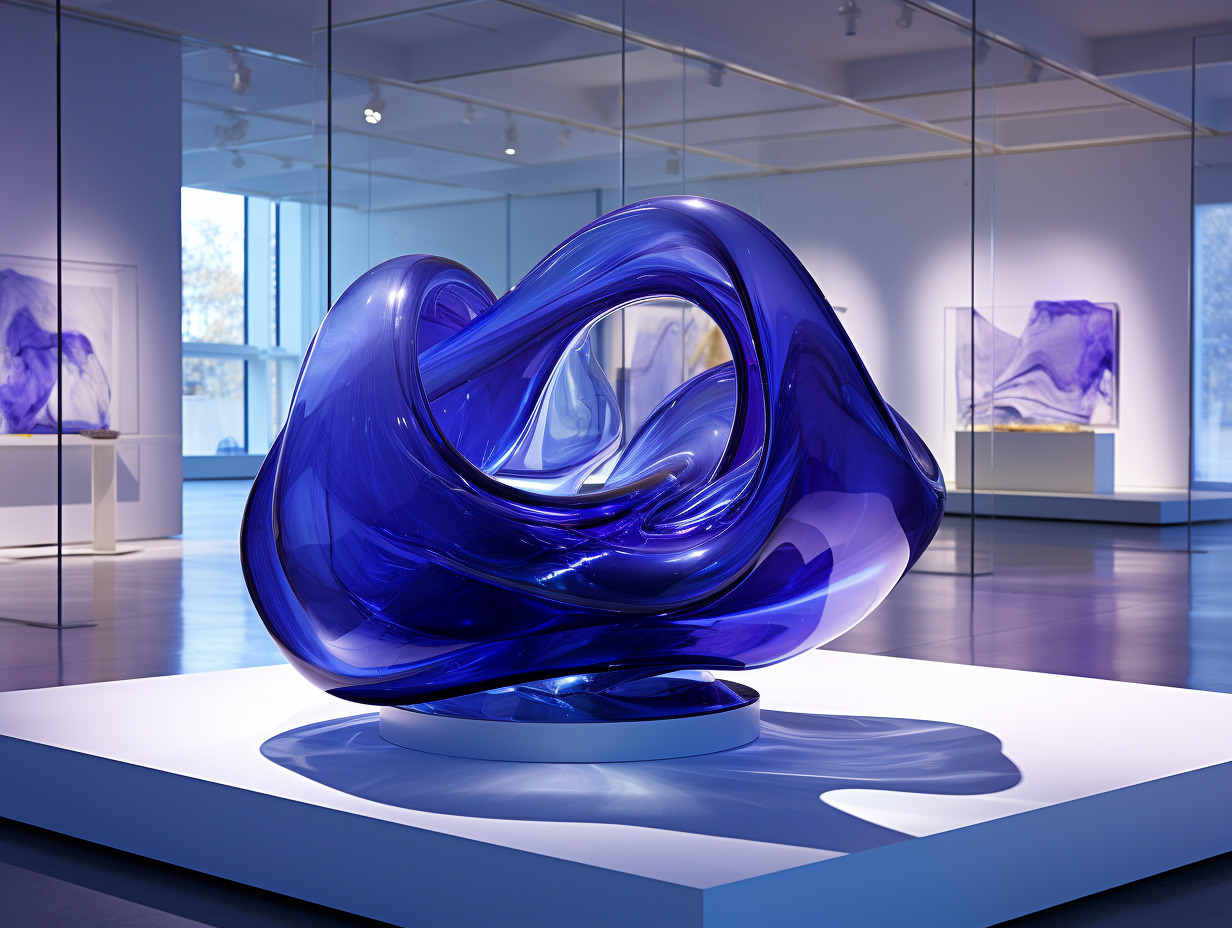
The power of Klein Blue lies in its ability to transform an ordinary space into a true permanent exhibition. Just like the Centre Pompidou in France or other museums in Europe, which regularly host Klein’s works, art lovers can now recreate this atmosphere at home. Whether on an entire wall or in small touches on decorative objects, IKB becomes a vector of modernity and elegance.
For those considering adopting this color, some decoration tips are necessary to avoid excess and enhance IKB. Balance is essential: pair Klein Blue with neutral colors like white, gray, or beige to create a harmonious contrast. Also, consider playing with materials, combining smooth and shiny elements with rougher and matte ones to exalt the uniqueness of IKB.
The first rule for successful decoration with IKB is to use it as an accent, a focal point that draws the eye and sparks interest. A single element, whether it be a piece of furniture, a painting, or even a textile, is enough to capture the essence of Yves Klein’s monochrome symphony. Adopting Klein Blue is thus choosing to marry art with the art of living, for a contemporary interior that pays tribute to one of the major figures of 20th-century art.